
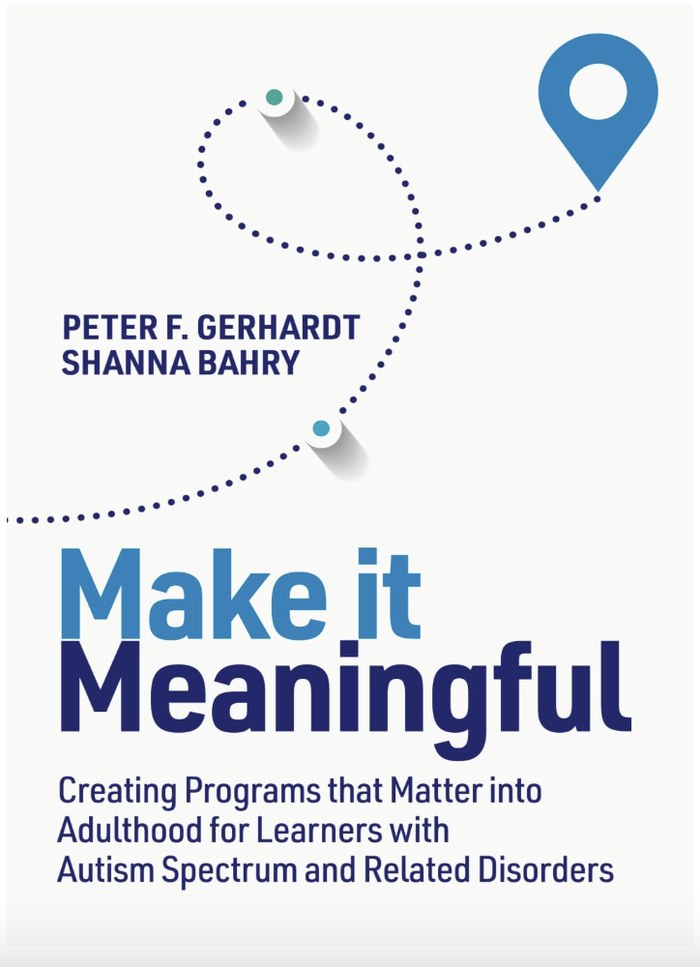
Peter F. Gerhardt, Ed.D. · Shanna Bahry, Ph.D., BCBA-D
Make it Meaningful
Creating programs that matter into adulthood for learners with autism spectrum and related disorders.
Teaching inconsequential skills well is no better than teaching essential skills poorly. This book is about the first decision — what to teach — and the framework, tools, and goal-writing discipline that follow from getting it right.
Practitioners make it meaningful. Parents make sure it’s meaningful.
The problem
Most programs are built for the next year, not the next thirty.
Goals get written, mastered, and replaced. Progress looks real on paper. Then services end, the structure disappears, and it becomes clear the program was never pointed at adult life at all.
This is rarely anyone’s fault. The training pipeline in this field is built around young learners, and so are most of the assessments and curricula that come with it. Very few practitioners were ever taught what adolescents and young adults actually need.
That is the gap this book was written to close.
Despite how evidence-based your interventions are, teaching inconsequential skills well is really no better than teaching essential skills poorly. What we teach needs to be as important as how we teach. Peter F. Gerhardt
Why it matters
The outcomes are not inevitable.
They are, however, entirely predictable when programming never changes direction.
of autistic adults in recent studies have poor outcomes in adulthood
are unemployed or underemployed, and often underpaid
continue living at home with their parents into adulthood
autistic teens will enter adulthood over the next decade
What’s inside
Four sections. Seventeen chapters. One argument.
What to Teach
Meaningful skills, the Meaningful Goal Guide, futures planning, and turning educational and medical necessity requirements into goals worth writing.
Chapters 1–4 →How to Teach
Adaptive behavior and ABA, leisure skills, community-based instruction, and targeting employment that actually holds.
Chapters 5–9 →Goal Building
Goal quality, the 20 Questions framework, balancing value against effort and risk, and structural integrity.
Chapters 10–13 →Assessing Quality
Outcome measures, social validity that means something, program-wide quality assurance, and leading a meaningful program.
Chapters 14–17 →Included with the book
Every tool, ready to print.
Buying the book includes access to digital copies of more than thirty tools the authors developed: instruments for guiding program development, customizable forms and datasheets, and visual job aids.
Your access code is printed on page xi, beside the QR code.
Among them
- The Meaningful Goal Guide (MGG) and its Early Learner Edition
- The Critical Skills — Futures Planning Tool
- The Job Match Assessment
- 20 Questions for Writing Meaningful Goals, with answer sheet
- Community-based instruction consent, assent, and emergency forms
- Program-wide quality assurance checklists
Endorsements
What the field says.
“This book can and should set a new direction for teaching services for people with autism spectrum and related disorders. Gerhardt and Bahry provide long-needed criteria and processes for developing, writing, and implementing skill acquisition strategies that will successfully prepare individuals to enter and experience adulthood. … Anyone involved in teaching individuals with intellectual and developmental disabilities (IDD) should read this book and apply its content. Higher education faculty who teach students to work with people with IDD, and especially faculty in special education and behavior analysis programs, should also ensure Make it Meaningful is required reading for every student.”
Dennis H. Reid, Ph.D., BCBA-DFounder and Director, Carolina Behavior Analysis and Support Center
“As young persons on the spectrum age into adulthood the number of people qualified and interested in addressing their social, occupational, developmental, and psychological needs is unfortunately quite small. Of that tiny group, Peter Gerhardt has stood out for decades. Now he and his co-author, Shanna Bahry, have supplied an extraordinary resource for anyone who wishes to join that group. I say resource because theirs is much more than a book. It is the documentary equivalent of a year long fellowship in adult services. … It is the epitome of a tour de force. But do not take my word for it. See for yourself.”
Patrick C. Friman, Ph.D., ABPPVice President of Behavioral Health, Boys Town · Clinical Professor of Pediatrics, UNMC
Keep in touch.
New continuing education, and occasional writing on the work.
Training, program review, and continuing education
Dr. Bahry works with schools, agencies, and clinical teams to put this framework into practice — staff training, program review, and on-demand CE.
The same argument, written for parents
Make Sure It’s Meaningful makes this case at length, in language written for the person on the other side of the table — so a family that was resisting the plan starts reinforcing it at home instead.